
When designing a dynamic and impactful visual experience for conference rooms, auditoriums, or public spaces, video walls have become a popular choice. Both LED and LCD video walls offer powerful display solutions, but they operate on different technologies and offer distinct advantages. Understanding the differences between these two options is key to selecting the best video wall solution for your needs.
Understanding the Basics: LED vs. LCD Technology
What is an LCD Video Wall?
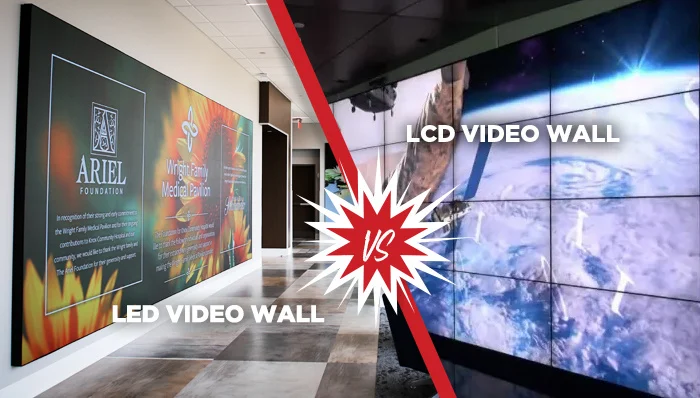
LCD (Liquid Crystal Display) video walls are made up of individual LCD panels joined together to create a larger unified display. Each panel contains liquid crystals, which adjust to block or allow light from a backlight (usually LED), forming the image. While LCD screens are widely used in consumer electronics like TVs and computer monitors, in a video wall application, they are combined into a matrix to create a much larger display surface.
What is an LED Video Wall?
LED (Light Emitting Diode) video walls consist of thousands of individual LEDs, which form the pixels on the screen. These walls don’t rely on backlighting like LCDs; instead, the LEDs themselves emit light and color. This enables LED video walls to deliver superior brightness and contrast, making them an excellent choice for larger, high-impact displays.

Key Differences Between LED and LCD Video Walls
Bezel Size and Seamless Display
One of the primary drawbacks of LCD video walls is the visible bezels (the frame around each display). Even with thin bezel designs, there’s still a small gap between the panels, which can interrupt the visual flow of content when multiple panels are used.
LED walls are known for their seamless design. Since there are no bezels or frames separating the panels, they offer a truly continuous, uninterrupted image. This is especially important for applications requiring a single, large image without visible lines, such as in digital signage, advertising, or immersive presentations.